
Who Was Yuri Gagarin?

Who was the man behind the legendary smile of Yuri Gagarin, the first human to travel into space in April 1961? What combination of talent, discipline and good fortune suddenly made him the ideal candidate among nearly 3,000 contenders?
“LET’S GO!”
Who Was Really the First Human to Orbit the Earth?
It is April 12, 1961, at Baikonur, then part of the Soviet Union and today located in Kazakhstan. At 9:07 a.m., Yuri Gagarin’s pulse rises dramatically, from 64 to 157 beats per minute. Sealed inside his spacecraft, Vostok 1, he lifts off from the launch pad while cheerfully exclaiming: “Poyekhali!” — “Let’s go!”
Who was Yuri Alexeyevich Gagarin, the man who became the first human being to travel into space and complete an orbit around Earth? Behind the smile that would become one of the most recognizable images of the twentieth century was a man whose charisma was matched by discipline, intelligence and humility.
At the end of a demanding selection process, Gagarin was chosen from roughly 3,000 potential candidates. The field was first reduced to about 200 Soviet Air Force pilots and later to a shortlist of 20 men selected under the supervision of General Nikolai Kamanin.

Credit: Arto Jousi / Suomen valokuvataiteen museo / Alma Media / Uuden Suomen kokoelma
Recommended Books About Yuri Gagarin and the Space Race


Beyond: The Astonishing Story of the First Human to Leave Our Planet and Journey into Space
View on AmazonAs an Amazon Associate, this site may earn from qualifying purchases.
Why Him?
The Perfect Profile
Gagarin appeared to fit the Soviet ideal perfectly. His very modest social background made him an ideal symbol of the egalitarian image the Soviet Union wanted to project. His natural charisma also impressed Sergei Korolev, the brilliant engineer behind some of the most important early Soviet space achievements, including Sputnik and the missions involving Laika.
But Gagarin was not selected merely because of his personality or background. He also performed exceptionally well in physical tests, technical examinations and psychological evaluations.
Soviet doctors reportedly praised his “high level of intellectual development”, as well as his strong powers of concentration and remarkable memory. He therefore represented almost the ideal candidate for a mission that was expected to demonstrate Soviet scientific and technological superiority before the entire world.
His popularity among the other candidates was equally revealing. During an informal vote among the 20 men on Kamanin’s shortlist, Gagarin was reportedly chosen by 17 of them — even though he himself did not vote for himself.

Credit: Public Domain
A Hero Larger Than the Mission
On April 12, 1961, Gagarin completed one orbit around Earth aboard Vostok 1 in approximately 108 minutes. At only 27 years old, he entered history.
His achievement went far beyond the success of a single cosmonaut. At the height of the Cold War, the flight represented a spectacular victory for the Soviet Union. A country that many outsiders still associated with rural poverty had suddenly demonstrated its ability to surpass the United States in one of the most advanced scientific and technological fields of the era.
The slogan “We are the first” became an expression of immense Soviet pride.
Gagarin himself possessed exactly the qualities needed to become the human face of that triumph. Friendly, relaxed, smiling and apparently comfortable with people from many different backgrounds, he traveled widely and met both world leaders and ordinary citizens.
Soviet authorities quickly understood the enormous political value of his popularity. Gagarin became not only a symbol of space exploration, but also an ambassador for an image of the Soviet Union as modern, scientific, confident and technologically powerful.
None of the Soviet cosmonauts who followed him would ever completely equal his prestige. Later achievements were remarkable, but Gagarin remained unique because he represented the moment when humanity crossed the frontier of space for the very first time.
A Humble Beginning
Yuri Gagarin was born on March 9, 1934, near Smolensk, into a rural family. His childhood was deeply affected by the Second World War and the German occupation of the Soviet Union.
After the war, he received technical training before joining aviation school and eventually becoming a military pilot. His intelligence, physical fitness, discipline and psychological stability helped him earn a place in the Soviet cosmonaut program.
His rise was therefore extraordinary: from a modest rural background to military aviation, then from the cockpit of a fighter aircraft to the first human spacecraft ever sent into orbit.
The Tragic Death of Yuri Gagarin
Seven years after his historic spaceflight, tragedy struck.
On March 27, 1968, Yuri Gagarin died during a training flight near Moscow. The news caused enormous emotion throughout the Soviet Union. Regular radio programming was interrupted and replaced by solemn music.
To Soviet citizens, Gagarin was no longer simply a famous cosmonaut. He had become a national hero and one of the most recognizable Soviet figures in the world.
The death of the first man in space abruptly transformed one of the greatest heroes of the Space Age into a legend.
Gagarin’s death seemed especially tragic because he had survived one of the most dangerous adventures humanity had ever attempted, only to die at the age of 34 during a comparatively routine aviation training mission.
His disappearance permanently fixed the smiling young cosmonaut of 1961 in the collective imagination.
His legacy remains much larger than Soviet history alone. The flight of Vostok 1 marked the moment when a human being first entered orbit around Earth and experienced our planet from space.
Yuri Gagarin’s Lasting Legacy
More than six decades after Vostok 1, Yuri Gagarin remains one of the defining figures of the Space Age.
His journey lasted less than two hours, but it fundamentally changed humanity’s relationship with space. It proved that human beings could survive beyond Earth’s atmosphere and opened the way for every crewed space mission that followed.
Gagarin therefore belongs not only to Russian or Soviet history, but to the history of humanity itself.
Yuri Gagarin Collectibles

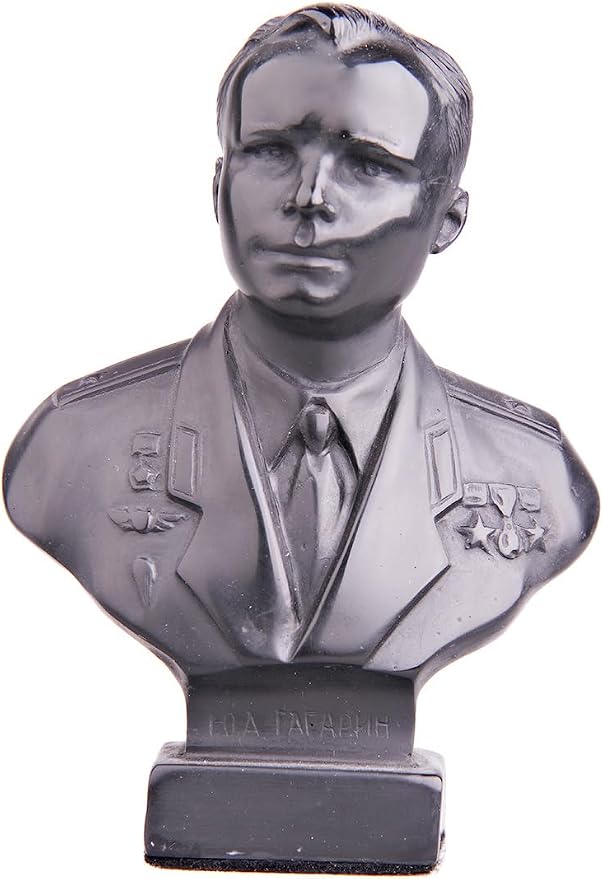
As an Amazon Associate, this site may earn from qualifying purchases.